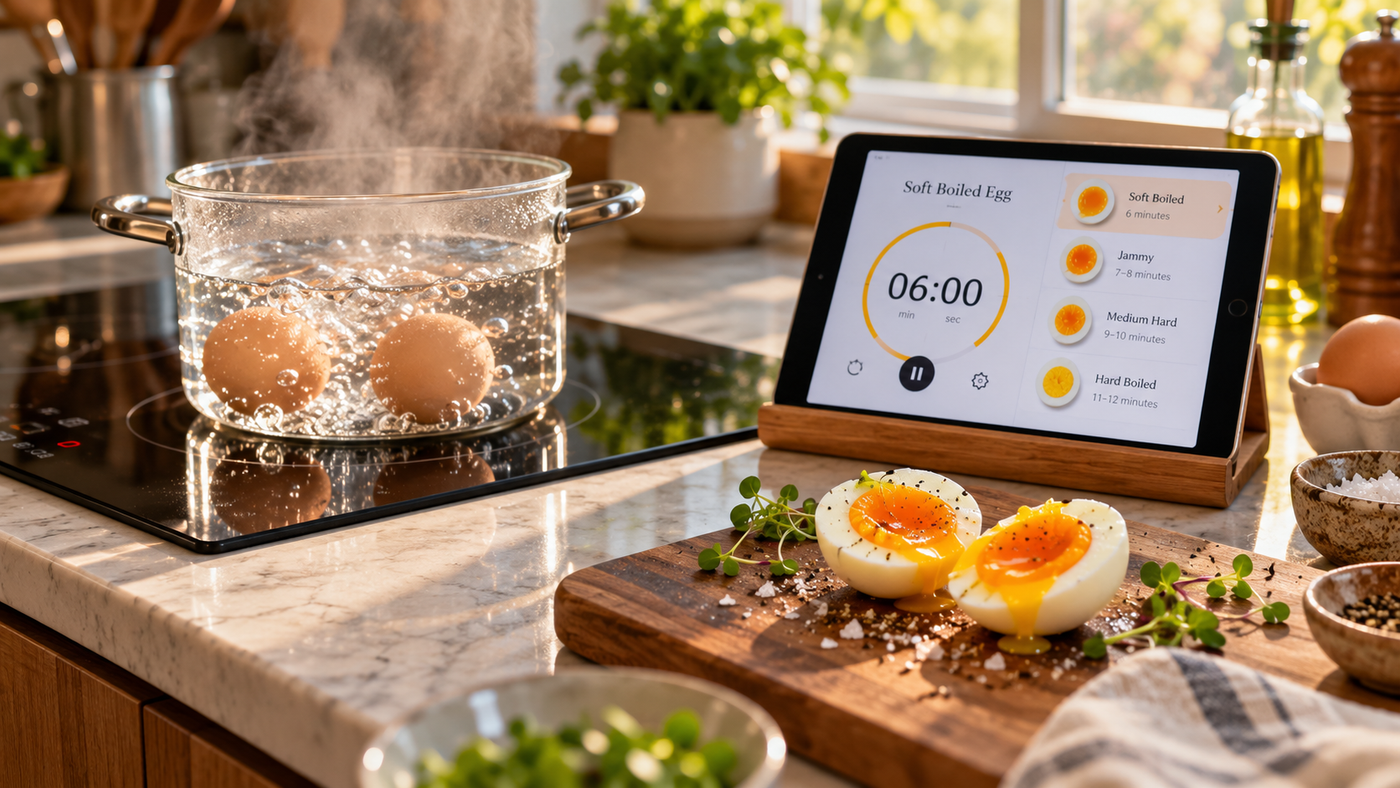
How to Boil Perfect Eggs Every Single Time: The Ultimate Online Egg Timer Guide
Have you ever peeled a boiled egg only to find a rubbery white surrounding a pale, chalky yolk with an unappetizing greenish-gray ring? Or maybe you were craving a rich, golden, jammy yolk for your morning toast, but ended up with a liquid mess running all over your plate?
Boiling an egg sounds like the simplest task in culinary history. Yet, it is notoriously one of the most frustrating things to get right in a home kitchen. A difference of just 60 seconds on the stove transforms a lush, runny center into a firm, solid block.
Whether you are prepping protein-packed snacks for your weekly gym routine, making classic American deviled eggs for a Sunday tailgate, or crafting jammy ramen eggs for a cozy weeknight dinner, timing is everything.
That is precisely why we created the free Online Egg Timer (opens in a new tab).
In this guide, you will learn the exact science behind boiling eggs, how factors like egg size and altitude impact your cooking, the secrets to effortless peeling, and how to use our digital countdown tool to achieve restaurant-quality results every single morning.
Why Mechanical Kitchen Timers and Smartphone Clocks Fail You
For decades, Americans relied on old-fashioned, spring-loaded kitchen timers shaped like tomatoes or little eggs. While they look cute on a countertop, they are notoriously inaccurate. As internal springs age, mechanical dials drift by up to a full minute—and in egg boiling, a one-minute error ruins your meal.
Smartphone timers are an improvement, but they come with their own hassles:
- Your screen locks while your hands are covered in water or cooking oils.
- Siri or Google Assistant mishears your prompt over boiling water noises.
- Setting custom intervals requires tapping through multiple app menus while your water boils over.
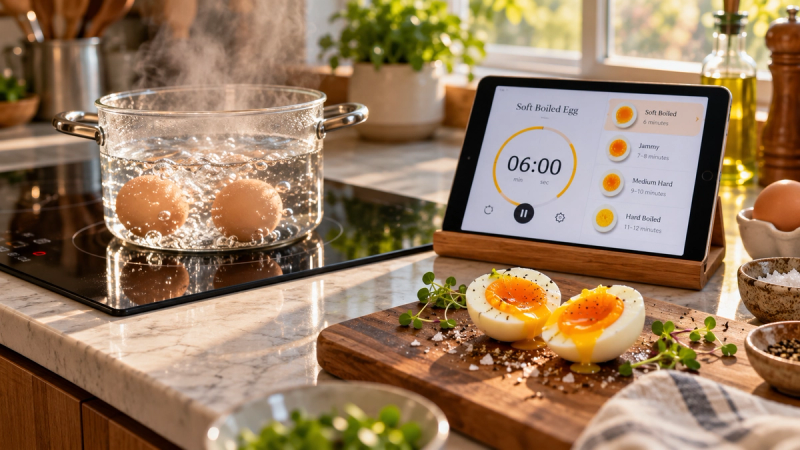
The Online Egg Timer (opens in a new tab) solves this by giving you a high-contrast, zero-drift digital countdown clock right in your web browser. With instant one-tap presets for Soft, Medium (Jammy), and Hard-Boiled eggs, you never have to guess or fumble with settings again.
The Culinary Science: What Happens Inside a Boiling Egg?
To appreciate why a precise digital countdown matters, it helps to understand what takes place inside an egg shell when exposed to heat.
An egg consists of two main parts, each made of different proteins that solidify (coagulate) at different temperatures:
- The Egg White (Albumen): Coagulates between 140°F and 180°F (60°C – 82°C). When cooked properly, it becomes tender and firm. Overcooked whites lose water rapidly, turning rubbery and tough.
- The Yolk: Coagulates between 145°F and 158°F (63°C – 70°C). Because the yolk sets at a narrower temperature range, even slight heat variations change its texture from warm liquid to thick custard, or to a dry, crumbly powder.
The Dreaded "Green Ring" Explained
If you overcook an egg or let it cool too slowly, the sulfur in the egg white reacts with the iron in the yolk, forming ferrous sulfide. This creates a dark greenish-gray ring around the yolk and gives off a harsh, sulfurous odor. It is safe to eat, but it ruins both taste and presentation.
By using the Online Egg Timer (opens in a new tab) to stop heat exposure at the exact second, you prevent this chemical reaction completely.
The Master Egg Boiling Chart (Large US Eggs)
In the United States, standard supermarket recipes assume Large Eggs (approx. 2 ounces or 57 grams each) dropped directly into boiling water from the refrigerator.
Here is your benchmark guide for timing:
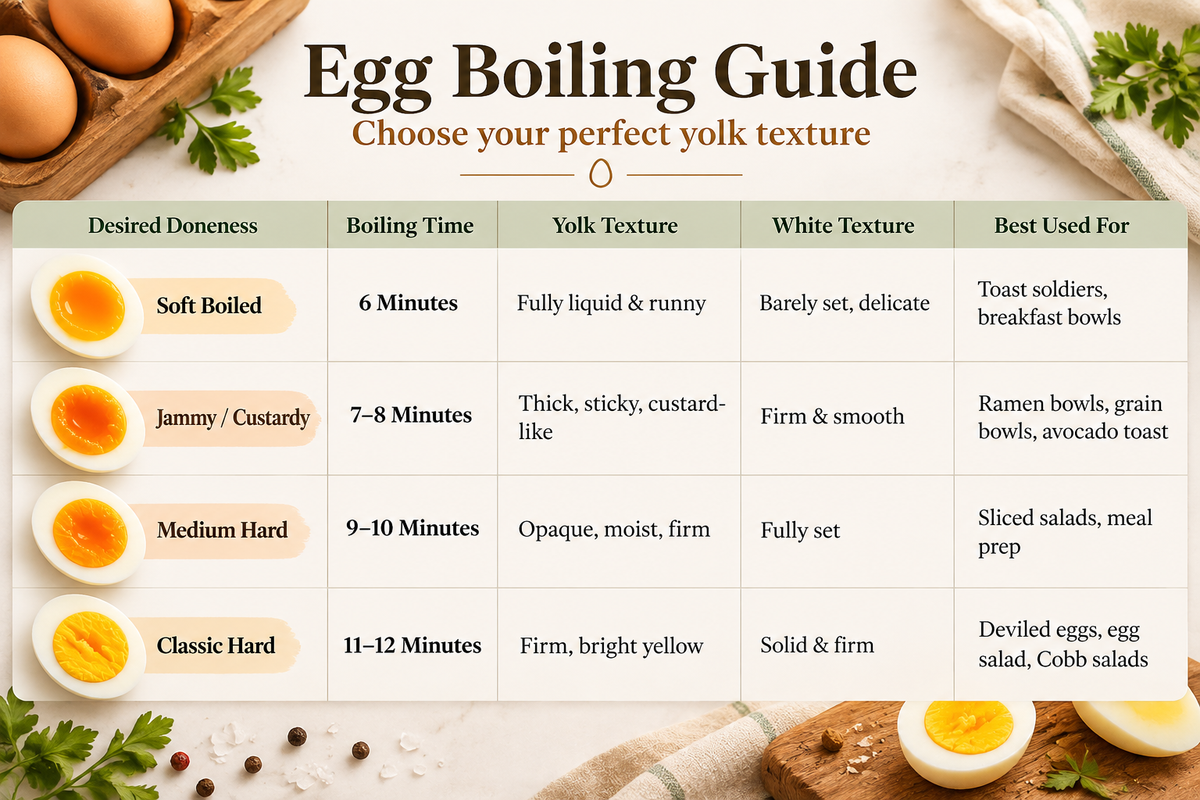
“⚠️ Warning: Anything beyond 13 minutes in boiling water risks overcooking, resulting in dry yolks and tough whites.
Step-by-Step Guide: How to Use the Online Egg Timer
Achieving perfect eggs takes less than ten minutes. Follow these simple steps every morning:
Step 1: Start with Boiling Water (The Hot-Start Method)
Always lower cold eggs into already-boiling water rather than starting them in cold water. Thermal shock causes the egg white to contract slightly away from the inner shell membrane, making peeling significantly easier later.
Step 2: Choose Your Preset on the Tool
Navigate to the Online Egg Timer (opens in a new tab). Select your target doneness preset or manually adjust minutes and seconds using the quick control buttons.
Step 3: Lower Eggs and Hit Start
Using a slotted spoon, gently lower your refrigerator-cold eggs into the boiling pot. Immediately click Start on the timer tool. You can leave the browser tab open while preparing the rest of your breakfast—the loud audio alert will let you know when time is up.
Step 4: The Non-Negotiable Ice Bath Shock
The moment the timer alert rings, lift the eggs out of the pot and plunge them into a bowl filled with cold water and ice cubes.
Leaving eggs on a plate to cool down slowly causes carryover cooking—turning your soft 6-minute egg into an 8-minute jammy egg within minutes. The ice bath cools the core instantly and locks in your preferred texture.
Crucial Factors That Adjust Your Boiling Time
While preset times work for standard Large eggs at sea level, real-world kitchens vary. Keep these variables in mind:
1. Egg Size Matters
- Medium Eggs: Subtract 30 to 45 seconds from preset times.
- Extra-Large (XL) / Jumbo Eggs: Add 30 to 60 seconds to preset times.
2. High Altitude Boiling (Denver, Salt Lake City, etc.)
Water boils at lower temperatures at higher elevations because atmospheric pressure is lower. Standard sea-level boiling occurs at 212°F (100°C), but in Denver, Colorado (5,280 ft above sea level), water boils at roughly 202°F (94.4°C).
- If you live above 3,000 feet, add 30 to 60 seconds to your timer.
- Above 5,000 feet, add 1 to 2 full minutes to achieve the same yolk firmness.
3. Fresh Eggs vs. Store-Bought Eggs
If you want easy-to-peel hard-boiled eggs, use eggs that have been in your refrigerator for 1 to 2 weeks rather than fresh farm-picked eggs. Over time, eggs absorb small amounts of air through porous shells, increasing the air pocket at the large end and making the shell peel away effortlessly.
Pro Tricks for Flawless, Crack-Free Eggs
- Add a Splash of Vinegar or Baking Soda: Adding 1 tablespoon of white vinegar to your boiling water will not affect taste, but if an egg shell cracks during cooking, the acid instantly coagulates the escaping white to seal the crack.
- Gently Tap the Shell Before Peeling: Crack the egg all over by rolling it gently on a clean countertop, then submerge it in water while peeling. Water slides under the membrane, allowing the shell to slide off in large pieces.
- Use a Slotted Spoon: Dropping eggs directly into boiling water from height often cracks the bottom shell on impact. Always gently lower them using a slotted spoon.
Complete Your Kitchen & Productivity Workflow
Timing your morning eggs is just the start of a smooth daily routine. Explore our full suite of free web utility tools designed to keep your day on track:
- Kitchen & General Timer (opens in a new tab): Need a multi-purpose countdown for baking bread, steeping tea, or roasting veggies? Use our zero-drift digital kitchen timer.
- Pomodoro Productivity Timer (opens in a new tab): Boost work focus after breakfast using structured 25-minute sprint intervals and short rest periods.
- Global World Clock (opens in a new tab): Working remotely or scheduling calls across time zones? Check live local times in major cities worldwide.
- Shared Alarm Clock (opens in a new tab): Synchronize reminders and alarms across multiple devices and team members instantly.
Frequently Asked Questions (FAQ)
Is this online egg timer free to use?
Yes! The Online Egg Timer (opens in a new tab) is 100% free with no account creation, paid upgrades, or software downloads required.
Will the alarm sound if I switch to another tab?
Yes. The digital countdown continues running accurately in the background, and the browser audio alert will play as long as your device volume is turned up and not muted.
Should I start eggs in cold or boiling water?
For accurate timing and easy peeling, always add eggs to already boiling water. Starting in cold water makes timing unpredictable because heating speeds vary across different stove burners.
Why do my egg whites turn out rubbery?
Rubbery whites happen when eggs are boiled too long or at excessively high temperatures without being shocked in an ice bath immediately afterward.
Stop Guessing and Upgrade Your Breakfast Today!
Don't let inaccurate timers ruin your morning routine. Whether you love runny soft-boiled eggs for dipping toast or perfect hard-boiled eggs for weeknight meal prep, precision makes all the difference.
Bookmark the Online Egg Timer (opens in a new tab) on your phone, tablet, or desktop browser today, and enjoy cooked-to-perfection eggs every single time!